London Tube strikes: What you need to know
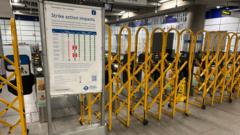
A series of six 24-hour strikes by drivers on the London Underground is due to take place, with the walkouts starting later this month.
Members of the Rail, Maritime and Transport (RMT) union voted to oppose the introduction of a four-day working week with condensed hours. The first strike is set to begin on Tuesday 21April at 11:59 BST, when two Tube lines will close entirely.
The union said it was concerned about shift lengths, unacceptable working time arrangements and the possible impact of fatigue on safety.
Transport for London (TfL) described the strikes as “completely unnecessary” and said it was currently trialling a voluntary four-day week for drivers on the Bakerloo line.
As it stands, members of the RMT union will strike on:
During the strike times, no service is expected on the Piccadilly and Circle lines, nor on the Metropolitan line between Baker Street and Aldgate. Central line services will not run between White City and Liverpool Street.
Due to the timing of the industrial action, the full impact on other lines will be felt at different times across the strike days.
Tuesday 21 and Thursday 23 April
Wednesday 22 and Friday 24 April
London Underground said there would be “significant” disruption on most Tube lines but the level experienced would not be as severe as the strikes in September.
Boarding the first Tube train may not be possible, according to TfL, with London Overground, the DLR, Elizabeth line, trams and buses expected to be busier.
A separate bus strike is happening on 24 April, affecting routes 8, N8, 25, N25, 425, 205 and N205, which operate from Bow bus garage.
Only drivers belonging to the RMT union are due to walk out – that is roughly half of the total number of drivers on the network. Aslef’s participation in last year’s strike with the RMT halted nearly all Underground services.
Many Tube drivers are set to turn up to work as usual, including members of the Aslef train drivers’ trade union – which accepted the proposals, labelling them “exactly the sort of deal every trade union should be trying to achieve”.
The RMT has rejected an offer for drivers to voluntarily work a four-day week.
Under the proposals, most drivers would see their working week reduced from 36 hours to 35 hours. Their contractual hours would remain the same because paid meal breaks would be introduced.
This effectively means drivers would work longer days, but fewer days each week and fewer overall hours each week.
The arrangement is currently being trialled on the Bakerloo line on a voluntary basis to test its viability.
The RMT said the working day would be too long under the plans, risking driver fatigue and compromising safety.
The union instead wants a 32-hour week over four days, meaning drivers would work three fewer hours each week for the same salary.
TfL said drivers could remain on a five-day week if they wanted to, pointing out that the change was voluntary.
A spokesperson for Aslef, the union representing a slightly higher share of Tube drivers, said on Monday they were “surprised that the RMT has decided to take this action”.
The union has agreed to the voluntary compressed four day week, saying it gives participating drivers an extra 35 days off a year “in return for some fairly minor changes to working conditions”.
“It will be the first strike in the history of the trade union movement designed to stop people having a shorter working week and more time off,” Aslef’s spokesperson added.
RMT confirmed on Saturday that Underground drivers would strike from Tuesday. The union said talks had failed and accused TfL of refusing to make concessions.
The RMT’s London transport regional organiser Jared Wood said there had been “extraordinary negotiations”.
“We called some strike action off four weeks ago to allow for negotiations after London Underground wrote to us describing what we had said to them as ‘thoughtful and worthy of exploration’.
“Four weeks on, I have received another letter saying that they are going to stick to their original position… and they are not prepared to discuss with us any further changes.
“It’s left our members in a position where they feel there is absolutely no alternative but to proceed with the strike action.”
The union’s general secretary, Eddie Dempsey, added: “The approach of TfL is not one which leads to industrial peace and will infuriate our members who want to see a negotiated settlement to this avoidable dispute.”
Claire Mann, TfL’s chief operating officer, said the proposals allowed it to “offer train operators an additional day off, whilst at the same time bringing London Underground in line with the working patterns of other train operating companies, improving reliability and flexibility at no additional cost”.
She added: “The changes would be voluntary, there would be no reduction in contractual hours and those who wish to continue a five-day working week pattern would be able to do so.”
London Underground drivers last went on strike in September in a dispute over pay and conditions.
The industrial action caused severe disruption across the capital’s transport network, with many Londoners getting around by e-bike instead.
Listen to the best of BBC Radio London on Sounds and follow BBC London on Facebook, X and Instagram. Send your story ideas to [email protected]