Rumen Radev's party wins Bulgarian election
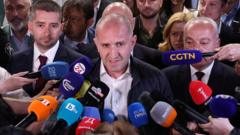
Rumen Radev’s Progressive Bulgaria (PB) party has won a landslide victory in Sunday’s Bulgarian election – the eighth general election in five years.
With almost 100% of the vote counted, his PB movement, only set up 4 months ago, won 44.7% and has secured a majority of 135 seats in the 240-seat parliament. It is the first time since 1997 that a single Bulgarian party has sufficient seats to govern alone.
Ex-prime minister Boiko Borisov’s GERB party came second with 13.4%, with the liberal PP-DB coalition third with 12.8%.
The election was called after the previous government tried to push through a controversial budget in December, prompting mass protests which Radev, as president, supported.
“People rejected the self-satisfaction and arrogance of old parties and did not fall prey to lies and manipulation. I thank them for their trust,” Radev said, in his victory speech.
He promised to build “a strong Bulgaria in a strong Europe”.
“What Europe needs right now is critical thinking, pragmatic actions and good results, especially to build a new security architecture and … recover its industrial power and competitiveness. That will be the main contribution of Bulgaria to its European mission,” he said.
Radev, 62, is seen as a pragmatic, somewhat pro-Russian leader, who has criticised EU sanctions, and called for constructive dialogue with the Kremlin.
He opposes Bulgarian military support for Ukraine, but is more likely to seek compromise than confrontation with fellow European leaders.
“Radev is unlikely to obstruct EU support for Ukraine,” said Philip Gounev, a security analyst in Sofia and former deputy Bulgarian Interior Minister.
“His approach will be pragmatic, more like Slovak premier Robert Fico than outgoing Hungarian premier Viktor Orbán.”
Not all his supporters are pro-Russian, meaning he will “be seeking a middle ground and present it as defence of the national interest – such as cheap energy resources to help the economy,” Gounev added.
In practice, that could mean continuing to allow crucial Bulgarian arms exports to Ukraine, but opting out of EU financial support.
He fought this election largely on domestic policies, promising to combat corruption, and restore stable government after years of weak and easily-toppled coalitions.
He stepped down after nine years as president in January to form his new movement.
A former Mig-29 fighter pilot and commander-in-chief of the Bulgarian Air Force, his victory is impressive by Bulgarian standards.
Every Bulgarian government since 2001 has ruled in coalition.
The result gives PB a mandate to govern alone, but will need the support of the party in second place, called “We Continue the Change – Democratic Bulgaria”, to pass key legislation ending political pressure on the judiciary, which requires a two-thirds majority.
Bulgaria is an important supplier of ammunition and explosives to Ukraine, through third countries, especially neighbouring Romania.
The war has given a boost to an arms industry which has struggled since the Soviet era.
Since 2022, Radev has frequently spoken out against the sale of the Bulgarian stockpile of Soviet era weapons to Ukraine, on the grounds that they prolong a war Ukraine cannot win – a similar argument to that made by outgoing Hungarian prime minister Viktor Orban.
The VMZ factory in Sopot, two hours drive east of Sofia, produces explosives and NATO-grade 155 mm artillery shells.
In October 2025, the German arms company Rheinmetall announced a €1bn joint venture with VMZ, to produce up to 100,000 155mm shells a year.
A separate gunpowder factory will also be built in Sopot. Rheinmetall will have a 51% share in the company.
Production will be part of efforts across Europe to scale up military production.
While he opposes military supplies to Ukraine, Radev took credit for inviting the CEO of Rheinmetall, Armin Papperger to Bulgaria in March 2025.
“Bulgaria is becoming part of the European defence ecosystem,” Radev said, on a visit to the Rheinmetall headquarters in Unterluss, Germany, in August 2025.
His position, as head of government, seems likely to be similar to that of Slovak Prime Minister Robert Fico – critical of EU support, but not imposing a veto on the manufacture of arms by private companies for Ukraine.